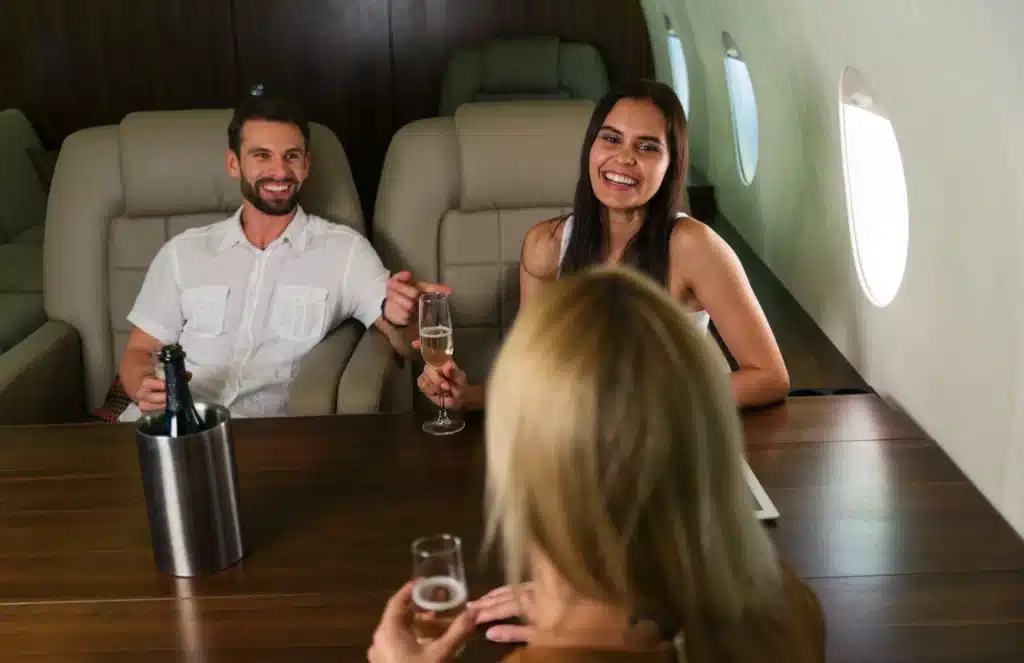
There is a moment, usually around the third trip of a busy week, when a charter operator finds out what its detailing products are really made of. A cabin window starts to look hazy in low sun. A leather seat dulls in a patch where it was wiped down after a spill. The walnut veneer on a side ledge loses its gloss. None of it happened in one go, and all of it could have been avoided by checking a document number before the bottle was opened.
Detailing a business jet borrows a great deal from detailing a luxury car: the microfibre, the patience, the eye for a smear. But the materials are different, and so are the consequences. The windows are stretched acrylic, the flight deck is a wall of coated displays, the cabin is lined in aviation leather and polymer-finished veneer, and the airframe is aluminium and composite that must not be corroded or embrittled. The products operators trust are the ones that have been tested against those materials. This guide explains what that testing means and names the products that pass it, job by job.
What “aircraft-approved” actually means
There is no single FAA stamp for cleaning products. Approval comes from the aircraft and engine manufacturers’ test specifications, and the ones that come up again and again are these.
- Boeing D6-17487. The exterior and general cleaning test. Products are checked for effects such as sandwich corrosion, acrylic crazing, paint softening and hydrogen embrittlement.
- Boeing BSS 7434, formerly D6-7127. The compatibility specification for cleaning products and aircraft interior materials.
- AMS specifications. SAE’s Aerospace Material Specifications, such as AMS 1550 for interior cleaners and AMS 1452 for disinfectants.
- Airbus Consumable Material List (CML) numbers. Airbus’s own record of tested and accepted products.
These tests are about compatibility, not about how well a product cleans. A product that passes has been shown not to damage aircraft materials. It is then up to the operator, working from the aircraft maintenance manual, to decide what goes on its fleet. That is why a professional detailer’s first question about any new product is not “does it work?” but “what is it approved to?”
Why car products fail on aircraft
The most common culprit is ammonia. Lee Aerospace, which manufactures and repairs aircraft windows, warns never to use glass cleaners containing ammonia because they damage windshields and windows, and to avoid paper towels, which scratch. ACI Jet, an interior completions specialist, is equally firm about cabins: never use glass cleaner of any kind on wood veneer, because it breaks down the polymer coating, and keep bleach, household disinfectants and alcohol cleaners away from leather. Many automotive glass cleaners contain ammonia, and many interior sprays contain exactly the solvents a completions centre would ban.
The products, by job
Windows, windscreen and flight deck displays: Alglas AGC/22 and Visial
The glass is where an aircraft is most obviously different from a car, and where the most specific evidence exists. Alglas, a British manufacturer based in Brixham, Devon, since 1986, makes cleaners for exactly these surfaces. Its AGC/22 glass cleaner is included in Boeing and Airbus maintenance manuals, is listed on Boeing’s own supply site against D6-7127 and AMS 1535, and was approved by Douglas Aircraft Company in 1988, which described it as a very efficient cleaner with no adverse effects. British Aerospace approved it for all cockpit transparencies, and British Airways has used it since 1987.
For the flight deck, Alglas’s Visial cleaner is lab-tested to reduce static build-up for at least seven weeks across displays and touchscreens, which keeps dust from being pulled back onto the screens, and the company recommends both products for corporate and business aircraft. The honest limit is scope: Alglas makes glass and display products, nothing for leather, veneer, carpets or the exterior, and it publishes no approvals specific to Gulfstream, Bombardier or Dassault.
The exterior: Aero Cosmetics Wash Wax ALL
Aero Cosmetics developed Wash Wax ALL in 1987 for washing without a hose. Its current guidance says the product meets Boeing D6-17487P and D6-7127M and Airbus 09-00-002, with test reports available from the company. It cleans and leaves a protective layer in one pass. Keep it off steps, floors, controls and pedals: its slick finish can make those surfaces slippery.
The belly and engine soot: Extreme Simple Green Aircraft & Precision Cleaner
The underside of any jet collects oil, exhaust residue and grime that a waterless wash will not shift. Simple Green’s aircraft formulation publishes its Boeing D6-17487 test results in full, including the acrylic crazing and hydrogen embrittlement tests, and holds AMS 1550B. Dilution matters: the maker gives 1:13 as the maximum strength that stays non-corrosive to metals and warns against letting it dry on the surface.
Brightwork: Nuvite NuShine II
Polished leading edges and engine inlets are where a detail is most visible from the ramp. Nuvite’s NuShine II range uses several grades for different levels of oxidation and surface repair. Its current tests and standards table lists grades IIF9, IIF7, IIG6 and IIC against Boeing D6-17487, D6-9002 and AMS 1650C. The grade and polishing method must suit the metal and its condition; this abrasive work needs a skilled hand and should be kept away from paint.
Leather: Aero-Sense Deep Cleaner and Leather Conditioner
Aviation leather is treated to meet flammability rules and does not respond well to car leather products. Aero-Sense, which produces its range mainly in Belgium, certifies both its leather cleaner and conditioner to AMS 1550 and Boeing D6-7127. Duncan Aviation’s advice on cabin leather and fabric is to blot, not rub, and to clean gently before conditioning. Aero-Sense publishes no business jet manufacturer approvals or named operators, and the range is sold on quotation.
Carpets, fabrics and odours: DASIC Aerokleen B Plus
A small, sealed cabin holds on to smells. DASIC, a UK manufacturer of aircraft interior products, makes Aerokleen B Plus, an enzyme cleaner approved to Boeing D6-7127 and AMS 1550B that breaks down organic stains and neutralises odours from fabric and hard surfaces. It is a spot and odour treatment rather than an extraction shampoo, so a deep carpet clean still needs separate equipment.
Lavatory and galley: Zip-Chem Calla 1452
For the hard surfaces that need disinfecting, Calla 1452 is one of the most widely approved products available, meeting AMS 1452, 1530, 1453 and 1550 and both Boeing D6-7127 and D6-17487, with Airbus CML and NAVAIR approvals and an EPA registration. It is for hard, non-porous surfaces only and has dwell-time rules, so it has no place on leather, fabric or veneer.
The detailing kit at a glance
| Job | Product | Approval evidence | Watch for |
|---|---|---|---|
| Windows and displays | Alglas AGC/22 and Visial | Boeing and Airbus manuals; D6-7127; AMS 1535 | Glass and screens only |
| Exterior wash | Aero Cosmetics Wash Wax ALL | Boeing D6-17487P / D6-7127M; Airbus 09-00-002 (maker) | Slippery residue |
| Belly and soot | Extreme Simple Green Aircraft | D6-17487 published in full; AMS 1550B | Dilution and drying |
| Brightwork | Nuvite NuShine II | D6-17487; D6-9002; AMS 1650C (listed grades) | Abrasive; skill needed |
| Leather | Aero-Sense Leather Care | AMS 1550; D6-7127 | Sold on quotation |
| Carpets and odours | DASIC Aerokleen B Plus | D6-7127; AMS 1550B | Not an extraction shampoo |
| Lavatory and galley | Zip-Chem Calla 1452 | AMS 1452; D6-7127; D6-17487; EPA | Hard surfaces only |
What about the wood veneer?
We could not find a veneer care product with a verifiable aviation specification, which is itself telling. Completion centres treat veneer as a finished surface to be dusted and wiped with a soft, barely damp cloth, never sprayed, never treated with glass cleaner, and any deeper work goes back to them. If a detailer offers to polish your veneer with something from a car valeting kit, say no.
Buying in the UK and Europe
Most published guidance on aircraft detailing is written for the US market. In the UK, several of these products are made locally: Alglas in Devon and DASIC among them. Aviation distributors such as Silmid and Transair stock many of the rest. Whatever the source, ask for the safety data sheet and the approval documents with the first order. A professional detailer should be able to show both for every product they bring onto the aircraft, and most FBOs and maintenance organisations will expect them.
Frequently asked
Can you use Windex on aircraft windows?
No. Lee Aerospace warns that ammonia glass cleaners damage aircraft windshields and windows.
What is the difference between a wet wash and a dry wash?
A wet wash uses water and rinsing in a wash bay; a waterless or dry wash lifts dirt with a spray-on product and cloth, and can be done on the ramp. Heavy soiling still needs a wet wash.
What does Boeing D6-7127 mean on a label?
It refers to testing against Boeing’s earlier interior-cleaner compatibility specification. Current supplier documentation commonly cites its successor, BSS 7434.
How should leather seats on a private jet be cleaned?
Gently, with a leather cleaner tested to aircraft interior standards, blotting rather than rubbing, then conditioning. Avoid bleach, household disinfectants and alcohol.
The products operators trust are not necessarily the most expensive or the best known. They are the ones with a document number behind them, used on the surface they were tested for, by someone who knows the difference.
Sources: Lee Aerospace aircraft window care; ACI Jet leather and interior guidance; Duncan Aviation fabric and leather guide; Alglas (alglas.com) and Boeing shop listing; Aero Cosmetics; Simple Green technical data sheet; Frasers Aerospace and Silmid (Nuvite); Aero-Sense; DASIC International; Zip-Chem; Tri-Point Aviation and OnGround Systems (competitor review).
Source documents: Zip-Chem; Cee-Bee; Aero Cosmetics; Nuvite; Nuvite 2